
(First created 10/23/19. Updated 4/12/25) A comparison of Capsule CRM vs. Infusionsoft—now, CRM vs....
HubSpot vs. Keap Is Really Apples & Oranges...
Since changing its release model in 2017, Keap has consistently rolled out new updates each month, such as:
- Many mobile app updates
- Mobile credit card reader
- Better Time Zone functionality
- Native Zapier integration for contact import
- BigCommerce integration
- Email builder improvements
- DKIM setup refinements
- Improved email-sending performance
- Increased security on orders
- PayPal update for Express Checkouts
- Filebox improvements
- Expanded International currency support, such as the Hong Kong Dollar and Vietnamese Dong

Likewise, HubSpot is always updating its application, and the list of updates for 2022 into 2023 is literally too long to list in its entirety, but some of the new HubSpot updates that stand out in my mind include:
- Accelerated Mobile Pages (AMP) to speed up your blog's performance
- Calling from Companies and Deals right from your CRM in the browser
- New web analytics dashboard
- Reinvigorated Tasks in the CRM
- OAuth 2.0 for developers
- CRM Extensions API and partnership with PandaDoc
- Live Chat for sales teams
- New reports for your dashboard
- Android App
- Easier to build dynamic pages with the HubDB (Bob loves this!)
- New social media tools
- New "unbounce contacts" button
- Automatically optimize videos hosted on HubSpot (this is huge)
- LinkedIn Sales Navigator integration with HubSpot CRM
As you can see, both HubSpot and Infusionsoft are not sitting on their heels. Stay tuned both here and to The Sales Whisperer® blog for more updates and insight on updates as they happen with both companies.
HubSpot vs. Keap For Current Users
If you own either of these platforms already and are only nibbling around the edges instead of going all-in on your business, stop reading now and commit to learning and mastering what you already own.
Check here to join the professional sales training program for live group training and a private group for real-time support.
If you need private help, Contact Me today, and we'll discuss what's right for you.
If you are still pondering which one to use for your business, take the Best CRM For Me free survey.
At the end of the day...
You're a busy entrepreneur with ADHD and Bright-Shiny-Object syndrome, so here's my (almost) unbiased recommendation after looking under the hood closely at HubSpot and using Infusionsoft since 2008 to grow my business and helping 2,355+ business owners do the same:
You need more of the right traffic, which you attract by creating great content with great offers that help you convert more window-shoppers into qualified leads that you can then nurture and bond and connect with to then make the sale and then over-deliver to then secure testimonials and referrals.
But ultimately, you need more sales. (I've never seen a business problem that couldn't be improved by doubling sales.)
Sure, traffic is a component of sales, but if you have a crappy site, crappier Calls To Action, and crappy follow-up, you won't be in business long.
Let's look at traffic generation for a moment.
HubSpot's main emphasis is on perfecting your "inbound marketing," which I love and support 100%, and it's how I built The Sales Whisperer®.
What put me off for so long on HubSpot was that I felt as though they were forcing me to pay THOUSANDS OF DOLLARS A YEAR, every year, upfront, to get help
- making a WordPress Page or Post,
- getting some social media ideas and
- tracking some analytics, you can get from Google for free.
But now I see they do so much more than that, and with the new HubSpot CRM, HubSpot makes much more sense for even smaller companies by not forcing you to pay for and connect that crucial component to your business.
I am not a "techie" or "geek" or "coder," but at the ripe young age of 39, while holding down a full-time job as I built my company, raising six (now seven) children with my stay-at-home wife who has home-schooled our kids since 2006, and coaching Little League and soccer, I self-taught myself WordPress and now have a site with 438 1,104 published Posts, 56 Landing Pages, and 53 published Pages with good SEO, good analytics, and enough traffic, leads, and deal flow to feed my family, keep a roof over our head, and take vacations in Hawaii.
Update 1/18: This site is my "money site," and I have since moved to the HubSpot COS to host my entire website, which you are reading now. However, many of my ancillary sites are still on the quite-inexpensive hosting mentioned above, although I am moving more and more of them to my HubSpot-hosted site.
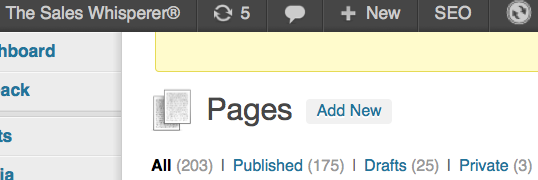
HubSpot vs. Keap WordPress Page Creation
(Before moving to the HubSpot CMS-hosted platform after seven years on WordPress.)
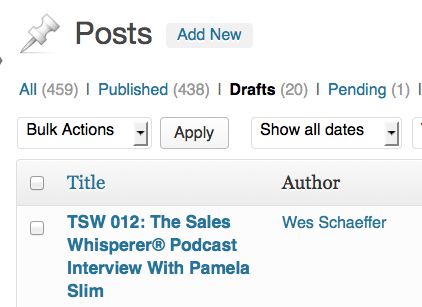
HubSpot vs. Keap WordPress Blog Post Creation
(Before moving to the HubSpot COS-hosted platform after seven years on WordPress.)
Eventually, you get tired of adding "free" and "low-cost plugins" from the open-source WordPress community or other entrepreneurs who have "GUARANTEED LIFE HACKS," "blogging hacks," "social media hacks," and "e-commerce hacks."
Sure, some of the tools are cool, and they work as advertised, but who supports them?
What does site speed cost you, which impacts bounce rates, page views, time on site, and conversions?
What does it cost you in terms of breaking your site, which I did more times than I care to admit when you add a plugin or update a plugin that conflicts with another and turns your website into a white page of nothingness?
Look, I'm all for bootstrapping to launch and grow a business. It's how I launched The Sales Whisperer® in 2006. But you get what you pay for.
I shudder to think of the late nights, early mornings, and missed sleep due to doing things on the cheap when it came to building and growing my website as I mastered Inbound Marketing.
Yes, there are free online groups and cheap overseas VAs you can hire to learn some things and knock out some technical work—and I still use both to this day—but not to do my heavy lifting.
At the end of the next day, surround yourself with experts, motivated entrepreneurs with great mentorship and great support, and do it affordably, which is why I recommend you take a long hard look at HubSpot's free Sales, Marketing, and CRM stack.
If you can build a web form in MailChimp or connect a sequence in AWeber or add a contact into Outlook or Gmail, you can leverage the free tools from HubSpot to get started mastering and profiting from your own inbound marketing.
(Seeing this kinda reminds me of Steve Martin in "The Jerk" when he saw his name in the phone book. All of these keyword ideas for free!! I'm somebody now!)
Affordable Inbound Marketing is the name of the game.
Let's look at these two pieces separately:
Affordability: As mentioned above, there is the price you pay to buy HubSpot and buy Keap, and there is the price you pay to own them. See HubSpot vs. Keap: True Total Cost of Ownership.
Just because some tools offer free trials or waive the setup fees doesn't mean they are cheaper to own and operate.
Dig deeper into the platforms.
HubSpot offers many free tools, including its CRM, Marketing, Sales, Service, and Operations.
With those free tools, you have access to superb training and documentation, which I stand behind wholeheartedly.
So what's the most affordable inbound marketing platform on the market when it comes to HubSpot vs. Keap?
I guess it all depends on how you define affordable.
I can't tell you how many wantrepreneurs I've spoken to over the years who talked a big game but couldn't back it up and would complain about how "expensive" Keap was, even though it was not.
In order to reel you in, Keap has finally learned from HubSpot's example, which is...
- Start Keap or HubSpot for free, then...
- Add on a module here or a user there for a low amount as you get comfortable with the technology and come up with new ideas...
- Upgrade to a full-featured package and really kick off your marketing automation and inbound sales then,
- When you have clear, documented, proven processes in place, step up the highest package and remain a happy, profitable user for years to come.
E-Commerce: If you need to process orders online, you're looking at an extra expense with HubSpot compared to Keap since HubSpot has no native e-commerce option.
There are platforms like Shopify, which start at $29—and I highly recommend—which give you best-of-class e-commerce features and HubSpot is rolling out a free, native integration with Shopify, so this is quite exciting if you are looking for elegant, seamless integrations between your CRM, commerce, lead capture, email marketing, and marketing automation.
But the original or classic Keap e-commerce platform is far from best-of-class. I'd say it's somewhere between functional to pretty good.
That being said, I've had more 5-figure months with the Keap e-commerce platform than I can count going back to 2008, including generating over $54,000 a month while working from home BEFORE COVID made it acceptable to work that way!
So you can make a lot of money with Keap, but understand that it's not a utopia with either platform.
Automation: This is a tough nut for most people to crack at first because they've just never experienced it, so creating sales and marketing automation needs to be easy.
You build out your HubSpot automation with what they call Workflows, which is fine but not as intuitive as Keap's graphically-driven Campaign Builder, which I've shown above.
Both HubSpot and Keap offer internal workflows to make your staff more efficient, as well as marketing automation, which helps you stay in front of your prospects.
The difficulty people have when setting up HubSpot or Keap is not the actual software but the thinking that goes into mapping out their ideal process. (That's why I offer the free planning tool I call "Process Before Login.")

As I've shown above, Keap gives you the ability to tie your email marketing to your shopping cart to your CRM to your affiliate marketing to your direct mail marketing to your SMS marketing (via 3rd party integration) to your voice broadcast marketing to your fax broadcasting (yes, some people still use fax machines) to your sky-writing marketing (Just seeing if you're still paying attention...but I am looking into planes and blimps and big kites so stay tuned.)
With HubSpot, you'll need a couple of third-party tools like Shopify to process payments online and an affiliate tracking platform if you want to sell through affiliates.
Otherwise, HubSpot offers everything Keap does and does so more elegantly, with a nice user interface and a faster platform. (See "HubSpot vs. Keap: Which CRM Is Fastest?")
Tying all of that together will take a little elbow grease and brainpower, so it's a good thing we're here to help.
In conclusion...
Both platforms offer great business-building tools with different emphases and vastly different price points:
- HubSpot focuses on the top of the funnel/front of the pipeline by giving you frameworks for your social media and website content—but you still have to write the content to create the inbound marketing they—and I—say you need to grow. They also give you great analytics, elegant email templates, split-testing capabilities, superb training, and 24/7 live support.
- Keap offers a complete sales and marketing automation platform that includes CRM, Email Marketing, eCommerce, and affiliate marketing all under one roof and is found nowhere else at their *price point, along with good training and support. (*Salesforce bought ExactTarget—who already bought Pardot—for $2.5 billion in June 2013 to bring this type of integrated automation to big businesses that can spend $10,000 to $100,000 per month for CRM, email marketing, and automation.)
So when it comes to HubSpot vs. Keap, you may have a tough choice to make.
If you are a small to medium business with a small marketing budget, Keap now has a truly free plan as well as a Lite plan for as little as $75/mo, but it's really for solopreneurs and/or beginners.
HubSpot has a free plan to help you get started, and you can scale up slowly to $50/mo, then $800/mo, and they offer great training for an entire year with that package.
If you have the money for the "best" platform, you'll soon discover why HubSpot is considered the founder of "inbound marketing."
When it comes to speed, HubSpot wins hands down.
If you're still unsure which is right for you, contact me here, and let's discuss it.
I'll help you make the best choice for your unique situation.
Market like you mean it.
Now go sell something.